
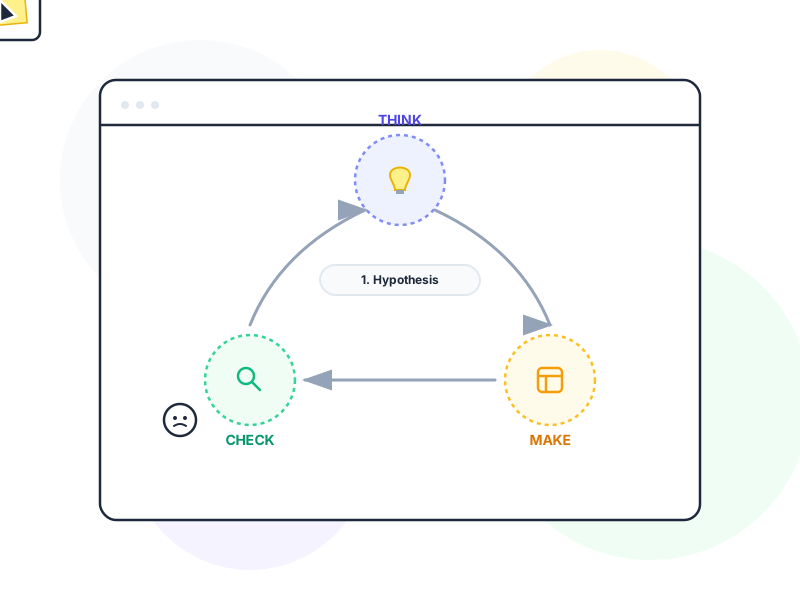
Lean UX is a design approach that replaces heavy documentation with rapid experimentation – instead of producing polished deliverables, teams form hypotheses, build the smallest possible test, and validate or invalidate their assumptions with real users before committing to full development.
Why It Matters
Traditional UX workflows often produce extensive documentation – detailed specs, comprehensive wireframes, exhaustive user flows – before a single line of code is written. This feels thorough. The problem is that it’s also slow, and it bets significant time and money on assumptions that haven’t been validated with real users. By the time a product reaches users, the team has already invested months in a direction that may miss the mark.
Lean UX inverts this. The question isn’t “what are we building?” – it’s “what do we need to learn, and what’s the fastest way to learn it?” Deliverables become a means to an end rather than the end itself. A rough sketch tested with five users on Tuesday beats a polished prototype that takes three weeks to produce and still hasn’t been seen by a real user.
This shift matters especially in cross-functional product teams. Lean UX breaks down the handoff model – where designers produce specs that get thrown over the wall to developers – and replaces it with continuous collaboration. Developers participate in discovery; designers participate in implementation discussions. The whole team owns the outcome, not just the design document.
How It Works / The Three Pillars
Lean UX sits at the intersection of three methodologies, each contributing a core principle:
Design Thinking contributes the human-centered foundation – deep empathy with users, problem framing before solution exploration, and rapid ideation. Design thinking ensures Lean UX is solving the right problem, not just solving a problem efficiently.
Agile development contributes the delivery rhythm – short sprints, continuous feedback, and the expectation that requirements will evolve. Lean UX aligns design work to sprint cycles rather than running ahead of development in a separate phase.
Lean startup contributes the hypothesis-driven mindset. Jeff Gothelf and Josh Seiden, who formalized Lean UX in their 2013 book, drew directly on Eric Ries’s Build-Measure-Learn loop. Every design decision is framed as an assumption to be tested: “We believe that [making the signup process one step instead of three] will achieve [higher completion rates] for [new visitors on mobile].”
The hypothesis statement is the core artifact of Lean UX. It makes assumptions explicit and testable rather than leaving them implicit in a design specification.
Hypothesis-Driven Design
Lean UX turns design decisions into falsifiable hypotheses. The template:
“We believe [doing this] for [these users] will achieve [this outcome]. We’ll know this is true when [measurable signal].”
This format forces clarity. Instead of “we should simplify the signup flow,” the team commits to: “We believe reducing the signup form from five fields to two for first-time mobile visitors will increase completion rates. We’ll know this is true when completion rate increases by 20% within two weeks of the change.”
A hypothesis that can’t be measured isn’t a hypothesis – it’s an opinion. Lean UX makes the difference explicit and gives teams a shared basis for deciding when to proceed, pivot, or abandon an idea.
A/B testing and lightweight usability testing are the primary tools for validating hypotheses. Both can run in days rather than weeks when teams aren’t waiting on polished prototypes.
When Lean UX Works Well
Lean UX fits naturally in environments that already value iteration and where the cost of shipping something imperfect is acceptable:
- Product teams within digital companies – the infrastructure for rapid deployment exists, the team is cross-functional, and there’s ongoing access to real users.
- Early-stage startups – the entire point is to validate assumptions before investing heavily. Lean UX’s minimal documentation overhead matches the resource constraints.
- Established products with active user bases – continuous discovery is possible because users are always available for testing or experiment observation.
When Lean UX Doesn’t Fit
Lean UX is not a universal solution. Two contexts where it breaks down:
Regulated industries. Healthcare software, financial products, and government systems often require detailed specification documents for audit, compliance, or legal purposes. Lean UX’s preference for “working software over documentation” directly conflicts with regulatory requirements that demand documentation. Teams in these contexts need hybrid approaches.
Agency and client work. When a design agency is building a product for a client, the client typically expects deliverables – not just validated learnings. Contracts are often structured around deliverable milestones. Lean UX’s output (validated insights, working software, team knowledge) doesn’t map cleanly to that billing model.
Real-World Example
A fintech startup building a new savings account product suspected that their signup flow was too long – requiring bank account connection before users could see their projected savings. The team formed a hypothesis: “We believe showing users a personalized savings projection before asking for bank connection will increase signups by 30%.”
Instead of redesigning the entire flow, a designer sketched a modified first screen in an afternoon. A developer built a functional version of just that screen the next day. Within two weeks, the team had run the modified flow with real users via usability testing and collected quantitative data via A/B testing. The result: a 41% signup increase. Total design documentation produced: the hypothesis statement, a rough sketch, and a one-page test results summary.
The team then committed to a full redesign of the onboarding flow – but only after the hypothesis was validated, not before.
How to Apply
- Start every design decision with a hypothesis. Write it down using the format above before opening a design tool. This takes five minutes and forces clarity about what you’re actually trying to achieve.
- Build the minimum test, not the ideal solution. What’s the simplest version of this idea you can put in front of a real user? That’s your starting point. A screen sketch taped to a wall is faster than a Figma prototype, and for many questions, equally informative.
- Define success metrics before you start testing. “We’ll know this worked when…” must be answered before the test runs, not after you’ve seen the data. Post-hoc metrics shift to match whatever happened.
- Involve developers in discovery. Lean UX works best when developers attend research sessions, not just receive handoff documents. Shared understanding replaces documentation dependency.
- Kill deliverables that nobody reads. Audit your design documentation. If a document exists primarily to show that design work happened rather than to communicate something specific to a reader, stop producing it.
Common Mistakes
Skipping the hypothesis. Teams adopt the Lean UX label while continuing to design based on intuition and stakeholder preference. The hypothesis is the discipline that separates Lean UX from just “moving fast.” Without it, you’re not validating assumptions – you’re just skipping documentation.
Treating Lean UX as an excuse to skip user research. “We’ll just build it and see” is not Lean UX – it’s skipping the “learn” half of Build-Measure-Learn. Lean UX requires more research contact with users, not less. The research is just faster and more targeted.
Applying it to work that requires documentation. Recognizing when Lean UX is wrong for the context is part of the methodology. Forcing it into regulated industries or contractual client work creates compliance risk and client dissatisfaction.
Related Concepts
- Design Thinking – the human-centered foundation Lean UX builds on
- A/B Testing – the primary quantitative tool for validating Lean UX hypotheses
- Usability Testing – the primary qualitative tool for rapid hypothesis validation
- Prototype – the lightweight artifact used to test hypotheses before full development
- User Persona – the team knowledge artifact Lean UX uses instead of formal persona documents