
Design thinking is a human-centered problem-solving framework that uses empathy, experimentation, and iteration to arrive at solutions users actually need. Instead of starting with assumptions about what to build, it starts with understanding people.
Why It Matters
Most product failures don’t happen because the technology was bad – they happen because the team solved the wrong problem. Design thinking flips the process: instead of building something and hoping users like it, you start by understanding what users struggle with. This reduces the risk of investing months into features nobody wants.
The framework is also a powerful communication tool. When designers, developers, product managers, and stakeholders share a common process, decisions happen faster and with less friction. Design thinking gives teams a shared vocabulary and rhythm – from research through ideation to prototyping.
Finally, design thinking encourages rapid failure. Building quick prototypes and testing them early means mistakes are cheap and learning is fast. A team that tests five wireframe concepts in a week will outperform one that spends three months perfecting a single direction in isolation.
How It Works / Types
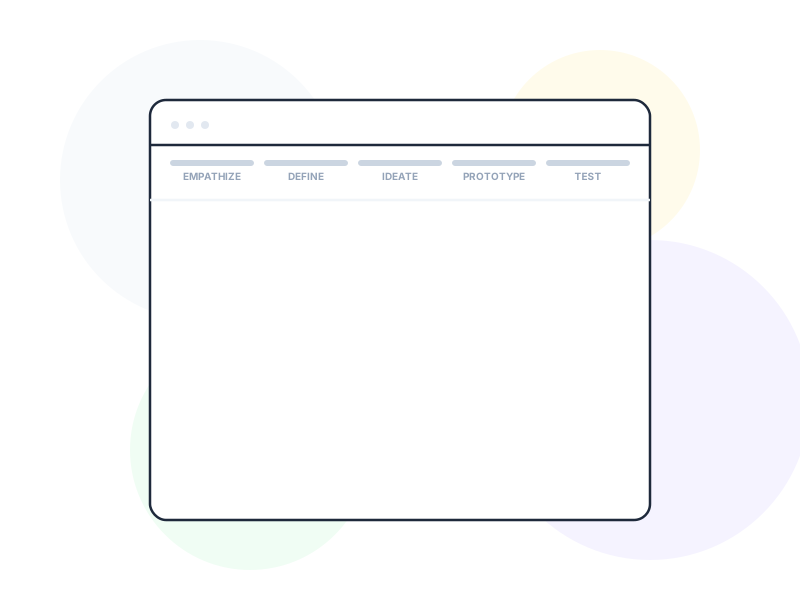
Design thinking typically follows five stages. These aren’t strictly linear – teams often loop back to earlier stages as they learn.
1. Empathize
Observe and engage with real users. Conduct interviews, shadow workflows, and listen without judgment. The goal is to understand what users do, think, and feel – not what they say they want.
2. Define
Synthesize your research into a clear problem statement. A good problem statement is specific and human-centered: “New parents need a way to track feeding schedules that works one-handed” is better than “we need a baby tracking app.”
3. Ideate
Generate as many solutions as possible. Quantity matters more than quality at this stage. Brainstorm broadly, sketch freely, and resist the urge to evaluate ideas too early. Techniques like Crazy 8s or How Might We questions help teams think beyond the obvious.
4. Prototype
Turn promising ideas into something tangible. Prototypes don’t need to be functional – paper sketches, clickable wireframes, or even role-played interactions work. The point is to make the idea concrete enough to test.
5. Test
Put your prototype in front of real users. Watch how they interact with it. Identify what works, what confuses, and what’s missing. Feed these insights back into earlier stages – then prototype and test again.
Real-World Example
When Airbnb was struggling in 2009, the founders didn’t add features or redesign the interface. Instead, they flew to New York and spent time with hosts, watching how they listed apartments. They discovered that poor-quality photos were driving guests away. The solution wasn’t a better upload form – it was a free professional photography service for hosts.
This is design thinking in action: starting with empathy (visiting hosts), defining the real problem (bad photos, not bad UI), and prototyping a solution (sending photographers) that no one would have proposed from a conference room.
How to Apply
-
Start every project with user research. Even a few informal interviews reveal patterns you’d never discover at your desk. Talk to 5 users before you sketch a single screen. Build user personas to keep your team focused on real people.
-
Frame problems as “How Might We” questions. Instead of “the checkout flow is too long,” try “how might we help users complete purchases with less effort?” This subtle shift opens the door to creative solutions.
-
Timebox your ideation. Give yourself 20 minutes to generate 10 ideas. Constraints boost creativity – without them, teams default to the first idea that sounds reasonable.
-
Prototype at the lowest fidelity that works. If you’re testing navigation structure, a paper sketch is enough. Save high-fidelity prototypes for later rounds when you’re validating visual details.
-
Test early, test often. Don’t wait until the design feels “ready.” Usability testing on a rough prototype catches fundamental problems before they become expensive to fix.
Common Mistakes
Treating design thinking as a rigid checklist. The five stages are a guide, not a recipe. Teams that march through empathize-define-ideate-prototype-test once and ship the result miss the point. The real power comes from iteration – looping back when testing reveals new insights.
Skipping research because “we already know our users.” Assumptions are the enemy of good design. Even experienced teams are surprised by what real user research reveals. What you think users want and what they actually need are often very different things.
Two tools strengthen the Empathize and Define stages: empathy maps make qualitative observations concrete and shareable across the team, and Jobs to Be Done analysis ensures the problem statement is grounded in actual user motivation rather than assumed preference. Lean UX principles complement design thinking by keeping hypothesis validation fast and reducing the risk of over-investing in any single untested direction.
Falling in love with the first idea. Ideation is supposed to generate many options, but teams often latch onto the first promising concept and stop exploring. Force yourself to generate at least five alternatives before committing to one direction.
Further Reading
- Design Thinking 101 – Nielsen Norman Group’s comprehensive overview of the design thinking framework and its phases
- What is Design Thinking? – Interaction Design Foundation’s guide to design thinking principles and methods