
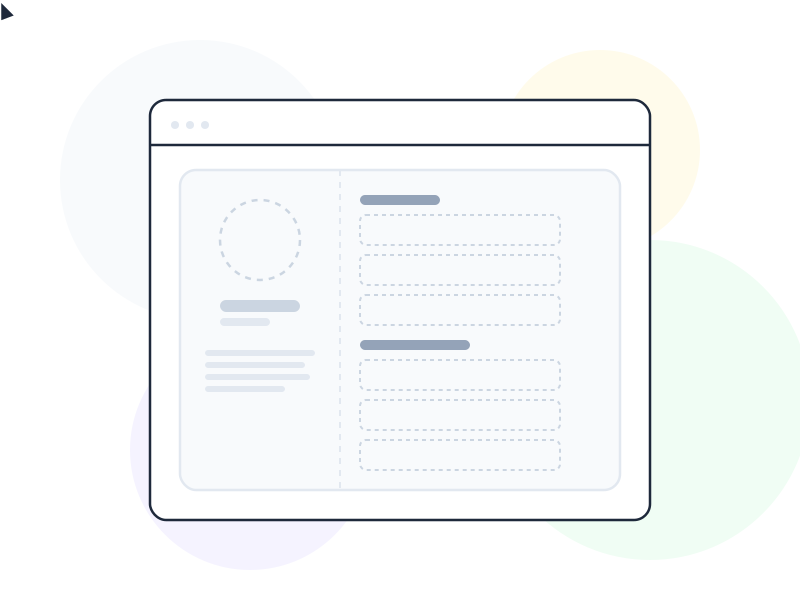
A user persona is a fictional but research-based profile that represents a key segment of your product’s users. It captures their goals, behaviors, pain points, and context – giving your team a concrete person to design for instead of a vague idea of “the user.”
Why It Matters
When teams design without a clear picture of who they’re building for, everyone fills the gap with their own assumptions. The developer imagines a tech-savvy power user. The product manager pictures someone who looks a lot like themselves. The result is a product that tries to serve everyone and ends up serving no one particularly well.
User personas solve this by creating a shared reference point. When a team debates whether to add a feature, they can ask: “Would Sarah – our primary persona – actually use this?” That question cuts through opinion-based arguments and refocuses the conversation on user needs.
Good personas also help with prioritization. Not every user group carries equal weight for your product. Personas make it explicit who you’re optimizing for and who you’re not – a strategic decision that’s often left unspoken until it’s too late.
How It Works / Types
Personas vary in depth and rigor depending on your resources and project stage.
Proto-Personas
Quick, assumption-based profiles created without new research. They capture the team’s existing knowledge about users and are useful for early alignment – but they’re a starting point, not a substitute for real data.
Research-Based Personas
Built from qualitative data: user interviews, contextual inquiries, and behavioral observation. A typical persona includes a name, photo, demographic snapshot, goals, frustrations, and a brief narrative about how they interact with your product. Most teams create 3-5 personas to cover their primary user segments.
Statistical Personas
Created by combining qualitative interviews with large-scale survey data. These personas are validated against quantitative patterns, making them harder to dismiss as anecdotal. They’re more expensive to produce but carry more weight in data-driven organizations.
For most projects, research-based personas hit the sweet spot – grounded in real data, but practical enough to create without a massive research budget.
Real-World Example
Imagine a team building a personal finance app. Without personas, designers might optimize for young professionals tracking daily spending. But user research reveals two distinct groups: recent graduates drowning in student debt who need help budgeting, and mid-career parents saving for their kids’ education who need investment guidance.
These groups have fundamentally different goals, anxiety levels, and financial literacy. A single dashboard can’t serve both without trade-offs. By creating personas – “Alex, 24, first job, $30K in student loans” and “Maria, 38, two kids, wants to start a 529 plan” – the team can make deliberate decisions about what to prioritize on each screen and what to tuck behind navigation.
How to Apply
-
Start with real research, not assumptions. Interview 5-15 users from your target audience. Ask about their goals, daily routines, frustrations, and how they currently solve the problem your product addresses. Patterns will emerge – those patterns become your personas.
-
Focus on goals and behaviors, not demographics. A persona’s age and job title matter far less than what they’re trying to accomplish and how they make decisions. “Wants to feel confident about retirement savings” drives design decisions. “Female, 35-44, household income $85K” does not.
-
Limit yourself to 3-5 personas. If you have 12 personas, you effectively have none. The purpose is to force prioritization. Identify one primary persona – the person you’ll optimize for when trade-offs arise – and a few secondary ones.
-
Make personas visible and accessible. Print them. Pin them on the wall. Reference them in design reviews and sprint planning. A persona that lives in a forgotten Confluence page serves no one. Keep real users present in every conversation.
-
Update personas as your understanding evolves. User needs change. Markets shift. Revisit your personas after major research rounds – typically every 12-18 months – and retire ones that no longer reflect reality.
Common Mistakes
Creating personas from imagination. Personas without research are just stereotypes. If nobody on your team has talked to real users, you’re guessing – and guesses tend to confirm existing biases rather than challenge them. Even five user interviews provide a more reliable foundation than a brainstorming session.
Overloading personas with irrelevant details. A persona doesn’t need a favorite book, a pet’s name, or a Spotify playlist. These fictional details feel creative but distract from what matters: goals, behaviors, and pain points. Every detail should help the team make a design decision.
Building personas and never using them. The most common failure mode isn’t bad personas – it’s abandoned ones. If personas aren’t referenced in design critiques, user flow mapping, and feature prioritization, they’re just an artifact from a workshop nobody remembers.
Personas work best alongside complementary research tools: an empathy map captures the emotional and behavioral context behind a persona in richer detail, while a journey map traces how that persona moves through a complete experience over time. For understanding why users choose a product in the first place, Jobs to Be Done analysis surfaces the underlying motivations that personas alone don’t capture.
Further Reading
- Personas Make Users Memorable – Nielsen Norman Group’s guide to creating effective, research-grounded personas
- What are User Personas? – Interaction Design Foundation’s overview of persona types and creation methods