
A minimum viable product in UX is the smallest version of a product that delivers genuine value to real users and generates the learning needed to decide what to build next – making it a strategic tool for validating assumptions before investing in full development.
Why It Matters
Building a complete product based on unvalidated assumptions is expensive. Teams spend months designing, developing, and polishing a product only to discover after launch that users don’t want it, don’t understand it, or use it in entirely different ways than expected. An MVP is the mechanism for exposing those assumptions to reality before the full investment is made.
The concept, central to Eric Ries’s Lean Startup methodology and foundational to lean UX, is built around a core insight: the goal isn’t to ship a product – it’s to maximize learning per unit of effort. An MVP that reveals “this approach is wrong” is more valuable than months of additional development on the wrong thing.
For UX designers, MVP thinking reframes the question from “what’s the best design for this product?” to “what’s the minimum design that will tell us if this product is worth building?” That’s a fundamentally different problem, and it produces fundamentally different (and usually faster) answers.
MVP vs Prototype – An Important Distinction
This is one of the most commonly confused distinctions in product design. A prototype is disposable – built to test internally, discarded after learning, never seen by real users in a production context. An MVP is real – it ships, it’s used by real users, and it generates real-world behavioral data.
The difference in context changes everything:
- A prototype can be a Figma file, a paper sketch, or a coded simulation. An MVP must work well enough for real users to get genuine value from it.
- A prototype can be shown in a controlled testing session. An MVP operates in the uncontrolled real world.
- A prototype failure costs the time to build it. An MVP failure can cost users and brand reputation if it’s too broken.
An MVP is not a rough prototype shipped to production. It’s a real, functioning product – with a deliberately limited scope.
”Minimum” Doesn’t Mean Bad Quality
A persistent misunderstanding frames MVP as an excuse for shipping something broken or embarrassingly incomplete. “It’s just an MVP” becomes a cover for poor execution.
The word “minimum” applies to scope, not quality. The features included in an MVP should be fully realized and properly executed. What’s minimum is the number of features, not the quality of the ones that are there. An MVP with one excellent, polished feature is better than an MVP with five half-built, buggy features.
The corollary: if the minimum viable version of your product requires functionality that can’t be built well in the available time, the MVP scope needs to be reduced, not the quality of what’s included.
The Cupcake Model
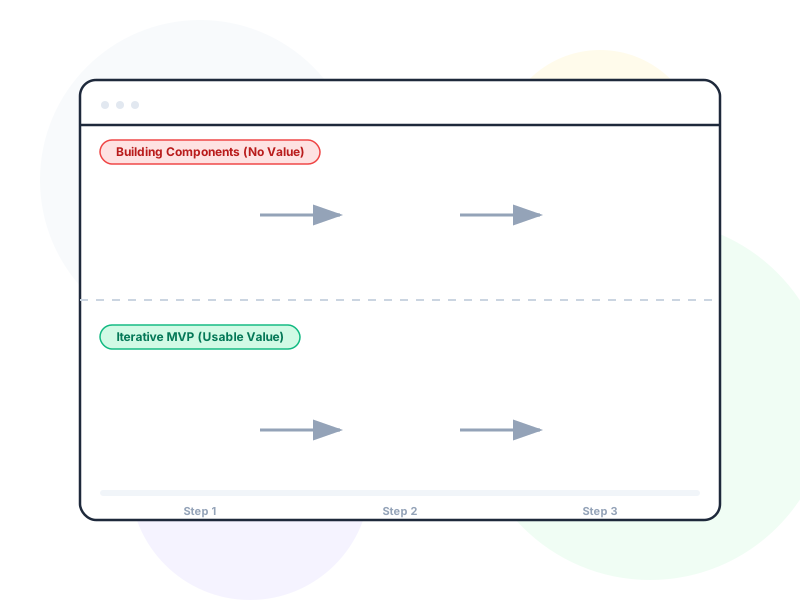
A useful mental model for MVP scope is the cupcake analogy (sometimes called the “skateboard model” in its original Spotify formulation). The wrong way to build toward a wedding cake is to start with flour, add eggs next month, add frosting the month after – delivering nothing of value at each stage. The right way is to deliver a cupcake first. Users can eat a cupcake. It delivers genuine value. It teaches you something about what people want. Then you build toward the cake.
In product terms: don’t build the database layer first, then the API, then the frontend, then the features. Build a thin vertical slice – a complete, working experience for a single use case – and ship that. Expand from there.
The cupcake model requires resisting the temptation to build horizontal infrastructure layers before any user-facing value exists. Every MVP sprint should produce something a real user can use.
When MVP Thinking Doesn’t Apply
MVP is not universally appropriate:
Safety-critical systems. Medical devices, aviation systems, financial infrastructure, and similar products cannot ship a “minimum viable” version that skips safety features. Regulatory requirements exist precisely because the cost of failure is too high to learn from it.
Regulated industries. HIPAA, GDPR, financial regulations, and similar frameworks require specific features and processes before a product can legally operate. “Ship and learn” doesn’t work when the learning comes from a compliance violation.
When you’re not actually ready to learn. An MVP only generates learning if the team has the capacity to observe what users do, interpret it correctly, and iterate based on what they find. Teams that ship an MVP and then move on to the next feature without analyzing the results get the cost of MVP without the benefit.
Real-World Example
Dropbox’s MVP is one of the most cited examples in startup history – and it’s notable for being a demo video, not a product.
In 2007, Drew Houston and Arash Ferdowsi had a working prototype of Dropbox’s sync technology, but building the infrastructure to scale it was expensive. Before committing, they needed to know if people actually wanted seamless file synchronization across devices. The answer at the time was unclear – the problem was poorly understood by most users.
Instead of building the full product, Houston recorded a three-minute demo video showing Dropbox working as it would when it shipped. The video was accurate – it showed the real product – but the product wasn’t ready for users yet. He posted it to Hacker News and a few online communities.
The result: the waiting list grew from 5,000 to 75,000 people overnight. The demand signal was unambiguous. The team then built the full product with confidence that users wanted it.
The Dropbox MVP validated a business assumption (demand exists) without building the infrastructure needed to fulfill it. The learning informed the investment decision. That’s the core purpose of an MVP.
How to Apply
- Identify the riskiest assumption your product rests on. What belief, if wrong, would make the entire product pointless? Design your MVP to test that assumption specifically. Everything else is secondary.
- Define what you’ll measure before you build. An MVP without success metrics is just a product launch. Decide in advance: what behavioral signal would indicate the MVP validated its hypothesis? What would indicate it failed?
- Cut features until it hurts, then cut one more. Teams consistently over-scope MVPs. Apply genuine minimum thinking: if a feature isn’t essential to the core value being tested, it doesn’t belong in the MVP.
- Build quality into whatever is included. The features that make it into the MVP must work well. A buggy MVP teaches you that the MVP is buggy, not whether the product concept is viable.
- Pair with usability testing before launch. Testing the MVP with a small group of users before release reveals usability blockers that would prevent the product from generating valid signal. If users can’t figure out how to use the MVP, the behavioral data is contaminated.
Common Mistakes
Shipping an MVP without defining success metrics. “We’ll know if it worked” is not a measurement plan. Define specific, measurable signals before launch. Without them, teams interpret ambiguous data to confirm their existing beliefs.
Using “MVP” to justify cutting accessibility and foundational quality. Accessibility features, security requirements, and data privacy compliance are not scope items that can be deferred to “after the MVP.” These are baseline requirements. An inaccessible MVP excludes users; an insecure MVP creates liability.
Never iterating after the MVP. The minimum viable product is a starting point, not a destination. Teams that ship an MVP, collect positive signals, and then move on to a different product without iterating have extracted only half the value of the MVP approach.
Related Concepts
- Lean UX – the methodology that MVP thinking operates within
- Prototype – the disposable testing artifact that precedes and differs from an MVP
- Usability Testing – the research method for validating MVP usability before and after launch
- Design Thinking – the human-centered process that informs what problem the MVP should solve
- A/B Testing – the tool for optimizing specific MVP elements after initial launch